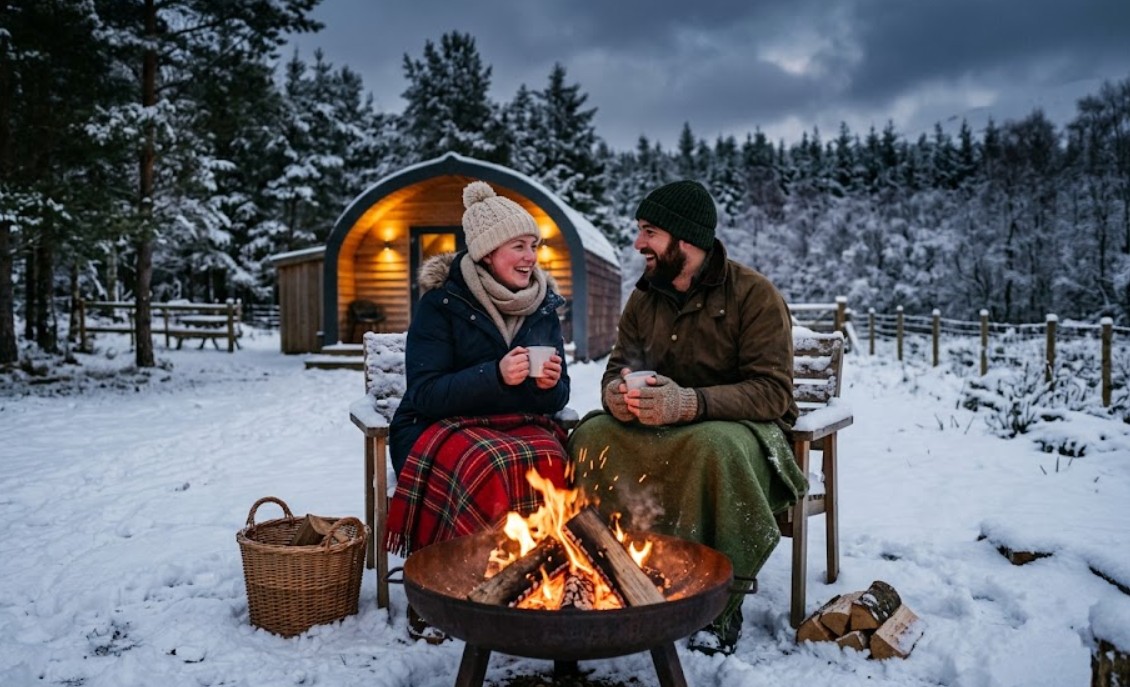
Fewer people. Sharper light. Star-filled skies with almost none of the light pollution that ruins a summer night. And crucially, proper heating built in, so "roughing it" no longer means shivering in a sleeping bag. A crackling wood burner, a private hot tub steaming away in the frost, a duvet you genuinely don't want to leave. This is camping with all the hard parts removed.
Here's where to find it, region by region, along with the facts, figures and history behind the trend, plus what to actually pack and budget for.
Why winter glamping?
Summer glamping is about long evenings and barbecues. Winter glamping is a different mood entirely.
It's cosy, quiet and a little indulgent. Most serious glamping sites now stay open through the colder months, kitting out shepherd's huts, yurts and pods with wood burners, underfloor heating and insulated canvas so guests are genuinely warm rather than just dry.
Sites also tend to be quieter and noticeably cheaper outside peak season. And the science backs up the stargazing appeal too. Cold winter air holds less moisture than summer air, which means less atmospheric haze and sharper, clearer views of the night sky. Dark sky experts specifically recommend autumn and winter as the best time to see the Milky Way overhead.
A growing market
Glamping isn't a niche any more. Around 60% of UK adults say they've either been glamping already or plan to, according to industry survey data cited by the Group Accommodation trade body.
Estimates of the UK market's current size vary a fair bit depending on the research firm, ranging from roughly £120 million to over £300 million depending on methodology, but nearly every forecast agrees on the direction.
Most analysts project the UK glamping sector to grow at somewhere between 8% and 11% a year through the early 2030s, driven by staycation demand, rising interest in eco-friendly travel, and a wave of new cabins and pods entering the market. Cabins and pods are currently the single largest accommodation category, making up close to half of all UK glamping revenue.
Where to go
Northumberland This is the one to know about if stargazing is the whole point of your trip. Northumberland National Park and the neighbouring Kielder Water & Forest Park together form England's first International Dark Sky Park, a Gold Tier designation awarded in 2013.
At 572 square miles, it's the largest area of protected night sky in Europe. On a clear night you can see thousands of stars, the Milky Way, and even the Andromeda Galaxy with the naked eye, roughly 2.5 million light years away. Kielder Observatory runs public stargazing events through the winter. Pair a stay here with a shepherd's hut or pod that has good glazing, so you can watch the sky without leaving your bed.
The Lake District & Cumbria Cumbria has some of the best cold-weather shepherd's hut stays in the country, many on working farms with fell views.
Look for huts with a wood-burning stove as standard, underfloor heating, and en-suite facilities, so you're not crossing a frosty field at midnight. Most huts in this region have wood burners built in as a baseline feature, not an upgrade. The Eden Valley and the fringes of the national park near Ambleside and Ullswater are good hunting grounds. Several sites here also double as bases for winter fell walking or a drive out to Hadrian's Wall.
The South Downs & Sussex Woodland glamping sites near the South Downs National Park lean into quirky accommodation. Think converted double-decker buses, old caravans and huts tucked into tree cover, each with its own private fire pit.
The South Downs also has its own Dark Sky Reserve, known as Moore's Reserve, and it's the closest of the UK's protected dark sky areas to London, about an hour's drive. Woodland canopy helps here in winter too, cutting the wind and giving each pitch a sense of enclosure that open fields don't offer.
North Norfolk Norfolk's glamping scene mixes off-grid simplicity with genuine comfort. Shepherd's huts and yurts here typically come with log burners, solar lighting, and private fire pits, often within reach of the coast and the Norfolk Broads.
It's a good pick if you want a proper digital detox. Expect limited mobile signal at the more remote sites. Nearby Holt is a good stop for shops and cafes if you want a break from the wilderness, and the North Norfolk coast makes for a bracing winter walk.
Yorkshire Yorkshire does winter glamping at scale. Larger sites here offer everything from off-grid yurts to insulated stargazing domes, complete with underfloor heating and glazing that lets you watch the frost settle from bed.
Yorkshire also has two of its own International Dark Sky Reserves, in the Yorkshire Dales and the North York Moors, the latter known for particularly strong Milky Way and Perseid meteor shower viewing. It's a solid choice for groups too, since sites here often cluster several accommodation types together.
The Cotswolds For a more polished, romantic winter break, the Cotswolds is where the hot-tub-and-wood-burner combination is at its most refined. Think shepherd's huts with a proper roll-top or outdoor bath alongside the log burner, aimed squarely at couples' weekends rather than family trips.
Wales Mid-Wales and the Welsh hills are popular for good reason. Yurts and huts here often come with a private outdoor hot tub as well as a wood burner, so you can go straight from a walk in the hills to soaking under the stars.
Wales also punches above its weight on dark skies. The Brecon Beacons, now known as Bannau Brycheiniog, was Wales's first Dark Sky Reserve and covers half the national park, despite sitting relatively close to Cardiff and Swansea. Several glamping sites in the region add festive touches for December stays specifically, from fairy lights and bunting to thick dressing gowns waiting by the door.
What it costs
Prices vary by season and location, but here's a rough guide.
A shepherd's hut with a wood burner typically runs £100 to £170 a night. A safari tent or hut with a hot tub sits higher, often £115 to £250. A fully-fitted treehouse or dome can go beyond that on a summer weekend.
Winter and midweek stays are usually noticeably cheaper than peak summer weekends, sometimes by as much as a third.
That's one of the strongest arguments for going glamping in the colder months in the first place. It also lines up with the wider market data: with demand still growing across the UK glamping sector, prices at the most popular sites tend to climb fastest in summer, so shifting your trip to winter is one of the simplest ways to get more for less.
What to pack for winter glamping
- Thermal base layers: even with a wood burner, huts cool down once the fire's out overnight
- Slippers or thick socks: floors in huts and pods are rarely heated underfoot
- A head torch: most rural sites have minimal outdoor lighting after dark
- Extra phone charger / power bank: remote sites often have limited signal and you'll want backup
- Wellies: winter fields and gravel tracks get muddy fast
- A hip flask or good thermos: for hot tub evenings or brisk morning walks
What to check before booking
- Confirm the heating source. "Heating" can mean anything from a proper wood burner to a small electric heater: ask specifically.
- Ask about winter access. Some rural tracks aren't suitable for all vehicles once the weather turns; a few sites will flag this, others won't.
- Check what's included. Firewood, bedding, and towels aren't always in the price: worth confirming before you arrive with none of your own.
- Look at cancellation terms. Winter weather is more likely to disrupt travel, so flexible cancellation policies matter more than they would in July.
Winter glamping trades long evenings for long lie-ins, and swaps the crowds for genuine quiet. Just make sure you pick a site that actually delivers on the heating.